

A response that starts
and then ends.
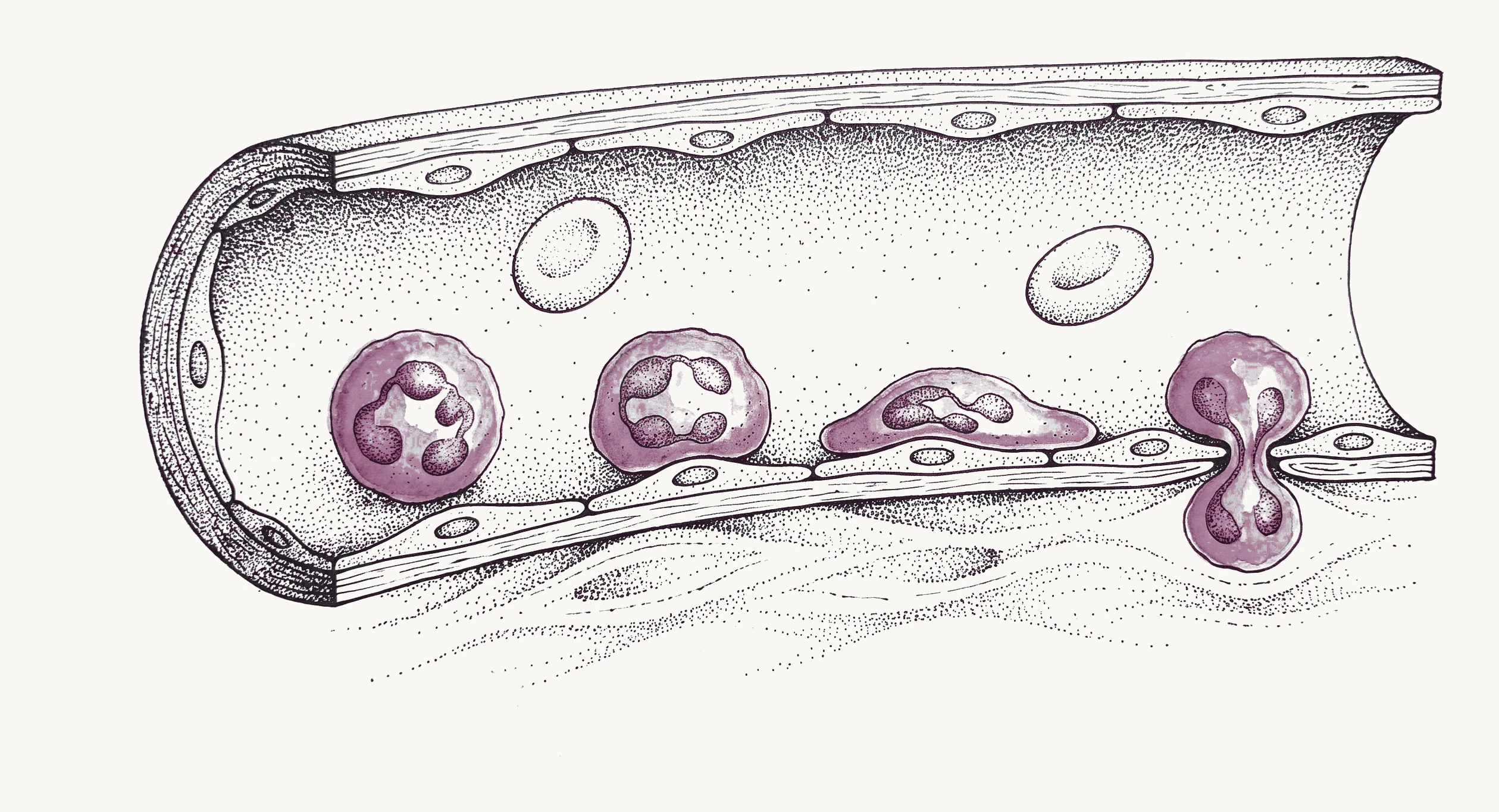
You cut your finger, catch a cold, or finish a hard run, and the same system responds. Immune cells nearby notice the change and send out signals. More immune cells arrive, deal with what is damaged or doesn’t belong, and clear it away. Then a second set of signals tells the response to stand down, and repair begins. That whole response, from the first signal to the last repair, is inflammation, and most of the time it does its work unnoticed.1, 3
- Activation starts a response
- Signals that raise the alarm and call in immune cells.
- Resolution ends it
- Signals that calm the alarm, clear away spent cells, and begin repair. Ending a response is an active, regulated process, not a response running out of steam.
Why it matters
to you.
Inflammation works for you all the time. It fights off an infection, repairs a strained muscle, and helps you recover after a hard day. A response that does its job starts when it’s needed, is strong enough for the work, and ends when the work is done. It can go wrong: a response can be too weak, or stronger than the situation calls for. It can fail to end, or stay active at a low level for years. Researchers have linked those patterns, especially persistent inflammation, with many long-term health conditions.4, 5
Inflammation also responds to how you live. Training, sleep, stress, food, and illness all change which signals your immune cells send, sometimes within days. So it’s worth knowing where yours stands today, and seeing how it changes when you change something.
Is lower inflammation better?
No. Picture two days. On the first, you catch a virus, and your inflammation response rises fast and strong: alarm signals go out, immune cells arrive, and they clear the virus. That strong response is what the day called for. On the second, the virus is gone, and the same response has settled back to its resting level, which is never zero. Both days show a system doing its job.
The trouble researchers describe is a response that stays up after the work is done, or never fully ends. The aim is a response that fits the situation, which is why lowering inflammation across the board is the wrong goal.3, 4
You cannot always
feel the change.
Persistent, low-grade inflammation often has no obvious symptoms. How you feel cannot tell you which immune programs are active.2, 5
Each test captures a snapshot. Illness, sleep and exercise can affect gene activity, so repeat measurements under comparable circumstances help describe change over time.
If symptoms concern you, talk to a clinician. A test of gene activity does not rule disease in or out.
Compare what different tests measure
What each kind of test actually reads.
The most common inflammation test is hs-CRP, which measures a protein your liver releases when inflammation is active somewhere in your body. It is well established and inexpensive, and doctors rely on it. It shows how much of that protein is in your blood, but it wasn’t designed to show which parts of your inflammation system are active or whether the signals that end a response are at work. Other tests read other layers, each on its own timescale.
Signal Layers · Fast to Slow Dynamics
Standard blood markers
(hs-CRP, ESR, ferritin, CBC/NLR, IL-6/TNF-α)Liver proteins, white-cell counts, and short-lived signaling molecules in serum.
Hours to weeks, depending on marker. hs-CRP rises in ~6h, peaks ~48h.
Which specific immune programs are running, or whether the switch-off is underway.
Cytokine-based aging clocks
A panel of circulating cytokines mathematically combined into an inflammatory age index.
Built from fast-moving signals, reported as a single summary number.
Which specific stage is active, or whether cellular resolution machinery is engaged.
Sayed 20218
Epigenetic clocks
(DNA methylation)Chemical methyl groups affixed to specific DNA CpG sites that alter with chronological age.
Slow: cumulative over years.
What the immune system is actively transcribing right now; real-time resolution status.
IgG glycan profiles
Branching sugar structures attached to circulating immunoglobulin G antibodies.
Slow-moving; shifts over months reflecting immune aging.
Which immediate immune transcriptional programs are active in circulating leukocytes.
Krištić 201413
Gut microbiome tests
Taxonomic composition and metabolic gene pathways of microbial populations in stool.
Variable; adapts across days to weeks following dietary and prebiotic shifts.
The actual systemic inflammatory and resolution execution within circulating human blood.
Franceschi 20187
Whole-blood transcriptomics
(RNA sequencing)Direct gene expression inside circulating white blood cells, plus cell composition estimates.
Hours to days (transcript turnover in circulating leukocytes).
Where in the body inflammation started; cannot substitute for direct tissue biopsy or protein assays.
These methodologies are not substitutes for one another. They measure different biological substrates across entirely different physiological time constants. The most comprehensive understanding of biological state pairs a fast-moving, reactive layer (such as circulating leukocyte RNA expression) with slow-moving cumulative metrics (such as DNA methylation).
Related on biomeme.com
How clinical labs, at-home kits, clocks and transcriptomics compare.
Evidence grades for eight circulating blood markers.
What can influence inflammation
What moves inflammation.
The biological factors that drive inflammation also serve as the primary levers for shifting it. Research consistently links these habits with lower circulating inflammatory signals:5
However, the quality and consistency of clinical trial evidence vary widely across different lifestyle interventions, supplements, and longevity compounds. Because individual biological responses diverge significantly based on genetics and baseline tone, measuring your personal immune trajectory over time shows what changed for you.
A view of inflammatory
gene activity.
The Inflammation Compass reads which genes your immune cells are using, from the signals that start a response to the signals that end it. It reports six readings, three for each, alongside an estimate of your immune cell mix.
The test describes systemic patterns. It does not locate inflammation in a particular organ, diagnose disease, or establish what caused a change.
Frequently asked questions.
Questions about inflammation and testing.
Is inflammation bad?
No. Inflammation protects and repairs you every day: it defends against infection and repairs tissue. The aim is a response that fits the situation and ends when its work is done. The concern in the research is a response that fails to end or stays active, not inflammation itself.
What's the difference between acute and chronic inflammation?
Acute inflammation is a rapid, localized, and noticeable defense reflex characterized by heat, redness, swelling, and discomfort; it resolves once the triggering pathogen or cellular debris is eliminated. Chronic low-grade inflammation is persistent, operates body-wide across circulating blood and tissues, and rarely produces overt symptoms, continuing undetected over months to decades.
Can you feel chronic inflammation?
Usually not. Unlike an acutely swollen joint or an infected cut, low-grade systemic inflammation doesn't usually cause pain, heat, or swelling. This is why objective molecular measurement is required to understand your baseline tone.
What is considered a typical hs-CRP range?
The American Heart Association and Centers for Disease Control (AHA/CDC) define high-sensitivity C-reactive protein (hs-CRP) cardiovascular risk categories as below 1.0 mg/L (lower relative risk), 1.0 to 3.0 mg/L (average risk), and above 3.0 mg/L (higher relative risk).10
Because a recent cold, injury, or hard workout can cause a temporary spike, the AHA/CDC statement recommends averaging two measurements taken about two weeks apart.
What is inflammaging?
Inflammaging refers to the gradual, sterile, low-grade elevation in baseline inflammatory tone that commonly develops with aging.6 It is driven by accumulated cellular debris, mitochondrial dysfunction, altered microbiome composition, and cellular senescence rather than acute infection.
Can a blood test show where inflammation is coming from?
No. Circulating white blood cells travel throughout the entire vascular tree, reflecting the body's integrated systemic response. Pinpointing a specific anatomical source or organ focus requires targeted clinical diagnostic imaging and medical evaluation.
What does “resolution” mean?
Resolution is an active biochemical process that brings an inflammatory response to an orderly close.3 Orchestrated by specialized pro-resolving mediators, it actively halts neutrophil influx, prompts macrophages to clear dead cells (efferocytosis), and initiates tissue healing.
How often should inflammation be measured?
Inflammation should be measured often enough to observe authentic longitudinal trends under consistent resting conditions, rather than over-reacting to transient day-to-day spikes. Customers choose their own cadence based on protocol milestones — commonly establishing a baseline, checking after one to three months on an active protocol, and checking periodically thereafter.
Start with your baseline.
One at-home blood collection. A report on your immune-cell gene activity.
$389 per test, or $365 each when you order 4 or more. Mobile phlebotomy and shipping included.
Sources and further reading
Peer-Reviewed Citations
- Medzhitov R. Origin and physiological roles of inflammation. Nature. 2008;454(7203):428-435. PMID 18650913. doi:10.1038/nature07201
- Nathan C, Ding A. Nonresolving inflammation. Cell. 2010;140(6):871-882. PMID 20303877. doi:10.1016/j.cell.2010.02.029
- Serhan CN, Savill J. Resolution of inflammation: the beginning programs the end. Nat Immunol. 2005;6(12):1191-1197. PMID 16369558. doi:10.1038/ni1276
- Fullerton JN, Gilroy DW. Resolution of inflammation: a new therapeutic frontier. Nat Rev Drug Discov. 2016;15(8):551-567. PMID 27020098. doi:10.1038/nrd.2016.39
- Furman D, Campisi J, Verdin E, et al. Chronic inflammation in the etiology of disease across the life span. Nat Med. 2019;25(12):1822-1832. PMID 31806905. doi:10.1038/s41591-019-0675-0
- Franceschi C, Bonafè M, Valensin S, et al. Inflamm-aging: an evolutionary perspective on immunosenescence. Ann N Y Acad Sci. 2000;908:244-254. PMID 10911963. doi:10.1111/j.1749-6632.2000.tb06651.x
- Franceschi C, Garagnani P, Parini P, Giuliani C, Santoro A. Inflammaging: a new immune-metabolic viewpoint for age-related diseases. Nat Rev Endocrinol. 2018;14(10):576-590. PMID 30046148. doi:10.1038/s41574-018-0059-4
- Sayed N, Huang Y, Nguyen K, et al. An inflammatory aging clock (iAge) based on deep learning tracks multimorbidity, immunosenescence, frailty and cardiovascular aging. Nat Aging. 2021;1:598-615. PMID 34888528. doi:10.1038/s43587-021-00082-y
- Pepys MB, Hirschfield GM. C-reactive protein: a critical update. J Clin Invest. 2003;111(12):1805-1812. PMID 12813013. doi:10.1172/JCI18921
- Pearson TA, Mensah GA, Alexander RW, et al. Markers of inflammation and cardiovascular disease: application to clinical and public health practice: A statement for healthcare professionals from the Centers for Disease Control and Prevention and the American Heart Association. Circulation. 2003;107(3):499-511. PMID 12551878. doi:10.1161/01.cir.0000052939.59093.45
- Horvath S. DNA methylation age of human tissues and cell types. Genome Biol. 2013;14(10):R115. PMID 24138928. doi:10.1186/gb-2013-14-10-r115
- Belsky DW, Caspi A, Corcoran DL, et al. DunedinPACE, a DNA methylation biomarker of the pace of aging. eLife. 2022;11:e73420. PMID 35029144. doi:10.7554/eLife.73420
- Krištić J, Vučković F, Menni C, et al. Glycans are a novel biomarker of chronological and biological ages. J Gerontol A Biol Sci Med Sci. 2014;69(7):779-789. PMID 24325898. doi:10.1093/gerona/glt190
- Chaussabel D, Quinn C, Shen J, et al. A modular analysis framework for blood genomics studies: application to systemic lupus erythematosus. Immunity. 2008;29(1):150-164. PMID 18631455. doi:10.1016/j.immuni.2008.05.012
- Altman MC, Rinchai D, Baldwin N, et al. Development of a fixed module repertoire for analysis and interpretation of blood transcriptome data. Nat Commun. 2021;12(1):4385. PMID 34282143. doi:10.1038/s41467-021-24584-w